Archive for the 'Uncategorized' Category


A turbanned santa

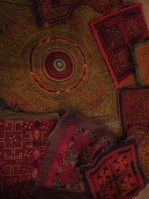
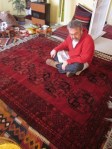
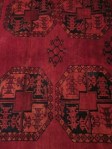
Each one of us found something under our Norfolk pine Christmas tree – Axel found a carpet he had been admiring at Wahid’s some weeks ago. Santa, helped by Wahid’s amazing memory, was able to find it between the 1000s of carpets heaped in enormous piles in Wahid’s shop. Steve was a co-conspirator and smuggled the carpet into our house.

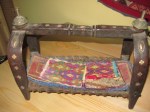
The other Santa did not make it back in time to get the real object of desire and disclosed it in a card. A picture of my present was hanging in the Christmas tree. It is a traditional cradle that has been described to me but I cannot quite imagine what it is like. Not that we are expecting a baby here – Axel picked it for its extraordinary craftwork.

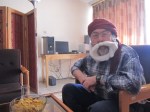
We cooked the winterfare and deserts for our dual hemisphere Christmas meal until it was time to leave. We dressed Axel up as an Afghan santa: a red turban (the guard helped him to wind my red scarf around his head), white cotton retrieved from pill containers served as beard and mustache, tied around his ears and neck with knitting yarn completed the set. Our Afghan staff looked on in wonder.

At Chris’ and David’s the cook was busy puttering in the kitchen where a large turkey was cooking, stuffed with pistachios, almonds, and raisins. We added our mashed potatoes, carrots and peas while our friend Steve from the consulate brought the necessary grape and hop based beverages to complete the meal.

We guessed our places at the table by looking at the contents of Christmas stockings. Mine was full of Dutch products, cheese, Douwe Egbert’s coffee and Axel had American stuff in his stocking. The men donned their Rudolph antlers, red blinking noses, while the women had flashing snowmen and christmas trees in their ears. We pulled at crackers and made wishes while little Kate checked all wrapped gifts for her name.

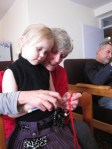
I gave her a beginner’s set of knitting needles with some red yarn but she was soon bored with the knitting lessons. Until she is ready for knitting the needles can be used as chopsticks.

Back home we opened the many electronic Christmas cards we received, each one taking a long time to download, and by mistake watched a movie about a family that didn’t get to celebrate Christmas together that left us depressed. We decided that this was the last time we celebrated Christmas without our kids – it’s no fun this way.

Christmassy

After my weekly massage and replenishment of oil in my dry skin we drove to the far northwest corner of Kabul to see M and her family in their new house.

We were greeted outside by her husband and inside found her mom, two sisters, one fiancé, one brother, M herself and her two boys. I have become like an auntie to them. The oldest is particularly affectionate and I get big hugs from him as often as he can give them.

We sat down in the blue room – blue walls, blue curtains and a blue carpet with cartoon racing cars. On top of that was a big Winnie the Pooh carpet, not what people would expect in Afghanistan. In the corner were two small desks from which the oldest boy pulled his first grade reader. We read together the story of the ugly duckling, a favorite children’s story here too.

When we visited M and her family a year ago in their rental apartment the cooking was done on the floor of the kitchen. Now she has a big light and airy kitchen.

Lunch was served on the ground as is common in Afghan households, on top of the plastic sheet that we claim has pictures of marihuana leaves on it.

When we left Axel noted the Norwood pine in the hallway and asked for the Dari word, having some idea of finding one on the way home. He should have known better to admire it because it was immediately offered to us, as Afghans are wont to do. We both protested as hard as we could but we lost and M claimed it wasn’t because we admired it. It was their Christmas gift to us. We drove off with the Christmas tree between us in the back side, tickling the neck of our guard. Bystanders smiled as they watched the two foreigners with their Christmas tree. It was the best gift we could have gotten.

On the way home we educated our driver and guard about Christmas. People have odd ideas about Christmas and New Year. We tell them it is our prophet’s birthday, just like they have theirs sometime in Spring and that new year is the beginning of 2011 and has nothing to do with Christmas other than that it is always one week later and also a holiday.

Axel has suffered from Christmas withdrawal in the biggest way, to the point of being a bit teary. The Norwood pine helped a bit. It now stands in our living room decorated with various stringed tchotchkies that I have collected over the year, two tiny Afghan mules on a keyring and one string of very brittle popcorn that took me forever to complete.

Axel was going to go out again for his usual last minute Christmas shopping but an explosion somewhere in town grounded the cars. It bothered him (not being able to get out and also the explosion) but for me Christmas has never been about gifts. The gift we are giving each other is our trip to Holland and India.

I had planned to make a buche the noel for our Australian Christmas lunch tomorrow. Maybe because I was too intently listening to Anna Karenina but it came out all wrong. The jelly roll fell apart and the chocolate and cream separated. I smooched the crumpled cake and the chocolate mixture into a bowl and will pretend it is a traditional Dutch Christmas concoction. It still tastes good but the look leaves something to be desired.

Since I has actually promised to bring a pumpkin cheese cake (the buche was a spontaneous addition to the menu) I tried to come up with at least one presentable desert. It did come out OK. There is more we have to prepare, all the winter vegetable dishes, since Australians celebrate Christmas in the summer and are used to light summer fare. It will be a trip tomorrow to see how the northern and southern hemispheres combine into one Christmas lunch.

Tears, naan and common goals

I just put Axel in a steaming hot bath. He was practically frozen stiff after spending three hours of teaching in an unheated house. His Afghan students are not fazed by this and their bodies don’t seem to cool off the way ours do. When Axel said goodbye to them and shook hands, theirs were warm, his were like ice cubes. I gave him a whiskey on the rocks to heat him up from the inside. He should be OK in half an hour.

I was dressed in a woolen overcoat and managed to stay warm during my one hour in the same cold classroom. We have started to read A Thousand Splendid Suns. Today only three girls showed up. Traveling after dark is difficult if not impossible for young girls or single women and so it seems we may have lost a few for the winter.

Not being able to find enough copies of the book to purchase one for everyone I copied the first 11 chapters so we could start. I know this is not quite proper and I hope the publisher accepts my apologies. I would have bought the books if I could have but Axel’s two attempts across town left us empty handed.

The reading levels of the girls are wide apart. One girl is maybe at 4th grade level, another at 6th grade and a third is at 10th grade. I sympathize with their challenge of learning to read and understand English and reading with the right intonation as I am learning to do the same in Dari.

The girls took turns reading a few paragraphs. We then went over the words they didn’t know and then I asked them to tell me in their own words what they just read. One of the girls had already read the book (as well as the Kite Runner) but didn’t mind reading it again. She will be my assistant because her vocabulary is considerable and she is able to explain many of the new words to her class mates. When they finally found the corresponding word in Dari I learned a new word as well; sometimes I was able to come up with the Dari word myself.

Although we were only at the very beginning of the intensely sad story, in this first class we already had tears even though the real sadness hasn’t even started. “Why do men hurt women’s feelings? Where do we begin to change that? What can we do? How could we possible change the men?” were the teary words from S. Instantly M. came to the rescue with words wise beyond her years, “Start small, start with your small brothers, cousins, nephews. Teach them about being considerate, treat women well.”

We were able to calm her down and read on but I am a bit worried if the first chapter already makes her cry, what will happen when we come to the really depressing parts?

In sharp contrast to this experience late in the day, several of my colleagues and I met earlier with the medical chief of the international security forces and his sidekick, a young woman who looked like she was just out of college but turned out to be an internist from Pensacola.

Getting the military folks to our compound was a major accomplishment. I exchanged many phone calls and emails with the gentleman in charge of transport. The military don’t know anything about the names of roads and neighborhood of Kabul as we and the Kabulis know them so none of our usual directions worked.

I finally gave them the longitude and latitude coordinates thinking that the military would know how to find us that way. But the reply was, “sorry ma’am, we don’t use that system.” In desperation I sent them the Google Earth map, which I couldn’t open myself, complemented by some extra instructions by phone. That seemed to work as they did arrive and dropped their officials off at our compound at the appointed time.

We had a good meeting and could have gone on for hours if they hadn’t been picked up by their details. There is much good that the military can do in the medical field – they have the expertise, the equipment, the means and the goodwill to give things like emergency care a huge boost here. We explored ways in which they can support the ministry and how we can work together. We saw a side of the military that few Americans get to see.

When the drivers and security people came back to pick up their charges we were not quite ready with our working lunch. Our kitchen staff sat them down in another conference room, flack jackets, helmets and all and served them the same fancy Afghan lunch we had given our guests. I was relieved that we had enough meals (as I would have ordered just the right amount). My Afghan colleagues commented that if you expect 6 people for a meal you cook or order for 18. That is exactly what they had done.

It is really bad form here to not have enough food when you have guests. There can never be too much food. And so we were able to feed the drivers and logistics officers a real nice Afghan lunch, something they don’t get in their army barracks. All was new and wonderful to them, even the Afghan naan (bread) that we so take for granted.

Delights ahead

We are busy organizing our trip to India and emailing with two agencies that claim they will delight us. The language of the emails is wonderful, as if we are talking with Jeeves, PG Wodehouse’s famous butler. Each new email is better than the previous one. We are being treated to one piece of adjective-laden after another:

“[…] India provides an authentic adventure – stimulating, absorbing, daunting, sometimes moving and shocking. Here is one of the world’s great dramas; an ancient, vast and crowded land committed to the most formidably challenging exercise in mass democracy. It is a spectacle in which hope, pride, paradox and uncertainty mingle and struggle. […] Here is a society of over a 1000 million people, growing by a million a month, divided and united by language, caste, religion and regional loyalties. It has often been described as a functioning anarchy; and it is in many ways an amiable one, of marvelous fluidity and tolerance. Indeed, the true Indian motif is not the Tajmahal, the elephant or the patient peasant behind the ox drawn plough. It is the crowd, the ocean of faces in the land of multitudes, endlessly stirring, pushing and moving. It is in this human circulation that one sees India’s colour, variety, busyness, and, senses also its power, vitality and grandeur.”

We are negotiating to lower the rather steep rates for our excursions. That too is met by the most wonderful prose: “Namaste & Good Morning Axel ! (Will you be offended if I addressed you by your first name ?, let me take a chance ! Actually, India is a pretty warm country and salutations as ‘Mrs.’, ‘Mr.’ are formal ‘wares’ as neckties which can be mistaken for the hangman’s noose !!!).”

He continues, “[…] Thank you for sharing your concerns with regards to cost. […] Axel, let us walk towards each other. I have walked USD 106 and I will request you to gently tread the other USD 94. Let us meet at USD 594 Per Person. […] Come on my friend, the hand remains extended in friendship and in goodwill – please hold and let me not fall !!! In all humility, I wish to state that, we do not promise just a tour. We are offering an experience. This is an experience that would communicate happiness, smiles and fulfillment. […].” He signs off with lots of love. There is the illusion (or is it pretense?) of deep friendship that is both creepy and seductive. We are definitely being seduced in a most wonderful prosaic way.

We are inclined to tell Mr. Manodj that we will go with the competition. Mr. M is the travel agent who Steve has used in the past and who is now organizing a tour for him and various family members following a similar route, but in a bus and for 10 days, a trip that starts tomorrow as he leaves Kabul for Delhi. But the prose of Mr. Banerjee is just too good to pass up. We will do a little more due diligence by checking some references but my heart has already decided.

Big stuff and small victories

Sometimes, when people ask about the big things we are supposed to produce, the ‘deliverables’ in our workplan and project document (Afghan ministry of health staff are managing and leading the health program competently so that the health of Afghans is improved – something like that) I feel a sense of incompetence, of failure. It is so hard to produce such outcomes when you have only influence, no authority to bring about positive change, most of it behavioral change of adults. Yet we promised miracles and we are held accountable. I am held accountable for my part of the Big Victory. The irony of all this is that if we had not made that promise we/I might not be here.

Since I have arrived over a year ago, or even earlier when I came as a consultant, we have been trying to implement activities that, at least on paper, should have, if not impact, then at least some measurable effect before we close the project nine months from now. My responsibility is to help my teams to produce changes in adult behavior and attitudes in a society and culture that doesn’t match the culture in which our models have been developed. There is little that follows linear causal pathways; there is much political interference; there are habits that produce effects opposite to intentions, at least in my eyes, yet they are maintained because they must fill some other function that is not visible to me.

A long time ago I learned that if you listen carefully to the stories of people’s lives, they tell them in a way that gives meaning to everything they do even if, to an outsider, they make no sense at all. As I learn more about the context of their lives, their histories, their experiences, their hopes, dreams, worries and fears and I begin to get it. That is when I realize the futility of some of our so-called change interventions. It is like trying to cheer up a depressed person with smiley faces and exhorting them to not be depressed.

In the absence of The Big Victory I don’t have the professional satisfaction of a job well done. Something I experienced as a consultant, the delivery of a report or the giddy feeling at the end of a workshop when everyone is happy and in high spirits and pondering the difference one has made while settling into the airplane seat for the long ride home.

Now, I don’t have those experiences. For one, the work is never done and secondly, the nature of the work isn’t like something you can check off from a to-do list. I have to seek my professional satisfaction elsewhere.

There are things that compensate for the buchari diesel fumes, the clammy cold of unheated concrete buildings, the intense air pollution, the restrictions on our movements, the terrible traffic and the constant bumps in the road.

They are the small victories of seeing someone change because they want to, and knowing that whether I am here or not, that change is permanent and will continue on its own.

It is when I see cracks in hardened opinions, a new insight peeking from behind the hard shell, an ‘aha!’ or an attempt to try out a new behavior; a woman who speaks out assertively and is emboldened by the experience; a beautifully written school application essay by a young Afghan man, after some coaching by Axel; my students drawing their visions and then starting the long journey towards realizing them.

A small victory is when nearly half the delegation from our project to a meeting with partners consists of women; when a new mom gets 3 months maternity leave instead of the one month she was given when her first child was born; the day care center (‘kodakistan’), now gender balanced, with 6 lovely little persons who run to greet me whenever they see me, letting me practice my Dari on them and asking me where the bubbles are (the giant bubbles I blew with them in the summer).

But my biggest small victory is that M is going to Egypt in less than a month to study something that is dear to our hearts: how to develop women leaders. We started working on this nearly a year ago. The obstacles were countless and big. We chipped away at them like a sculptor chiseling through hard rock to reveal something beautiful that was there all along and only needed to be uncovered.

Now, a year further, we are busy lining up our ducks, trying to make sure we haven’t overlooked anything that can derail this wonderful opportunity – it looks like we are good on the logistics, visas, money, and moving right along in structuring the experience. We still need to align others, at HQ and in Egypt, so that their efforts combine with ours to deliver the results we are looking for. This kind of thing gives me the lift I need to tackle the big stuff.
Working with bureaucracies

Last summer the responsibility for a gigantic medical equipment procurement was placed in my hands by a colleague who went on extended leave. I had to learn quickly what it takes to order 100s of pieces of medical equipment for hundreds of health facilities in a place like Afghanistan following US government regulations and Afghan standards.

I learned that there were no standards nor specifications and that someone knowledgeable had to do that. I learned that you need samples and some assurances that what you get is actually the same as the sample you were shown before you ordered and that you had to be alert to dishonest business practices.

I learned that you had to worry about time-to-delivery and whether we would still be around to pay the bill (and if not, who would) and that you needed storage space and figure out how the stuff would get to the facilities far away from Kabul.

The whole enterprise required hiring local staff to do the legwork and international experts to do the oversight and decision making about the quality/price/time to delivery formula. I got involved in the start up phase of this huge assignment by establishing a timeline and writing the job decsriptions for the people to be hired.

In September my colleague returned and I handed the whole thing back over to him, he reluctant, me smiling.

Now, four months later, I watch how the process unfolds, a process that looks more and more like an obstacle race. I have learned a lot since then about procurement. I have a new admiration and appreciation for my colleagues who are in charge of procurement, both local and worldwide and those who have to manage it.

I had no idea how complicated it is to get stuff, the right stuff of the right kind/quality, to the right people at the right price to the right place at the right time without (and this is the kicker) breaking any laws or violating any federal or national regulations.

When I look back at the timeline we developed in August I am astonished how far we were off. The complexity is tenfold of what I perceived at the time. Now, 4 months later many of the things we thought would be done by now, aren’t done and can’t be done for reasons that have to do with control and controls from this then that stakeholder. We are struggling to think of creative ways to get around each next obstacle that is put in our way, a new one around each and every corner.

This experience supports my assertion (adopted from James Q. Wilson’s Bureaucracy – Basic Books, 1989) that the freedom of bureaucrats to take action in the pursuit of efficiency is significantly, if not wholly, constrained by the decisions of their political superiors. The public sector cannot be efficient even if our lives depended on it (it’s own life doesn’t depend on it – a bureaucracy is forever).

In the public sector there is no straight line from A to B, there are no means that go directly and logically to ends no matter how much our plans and concept papers pretend they do.

People are sometimes shocked when I say this in public. Bureaucracies cannot be efficient because they are beholden to powerful stakeholders that care more, right or wrong, about interests and agendas of their constituencies than on managerial efficiency. I marvel how everyone always appears to discover this as an unpleasant surprise even though their daily lives at work are constantly upset by this reality.

Processing

I started downloading the audiobook The Decline and Fall of the Roman Empire (Part I) about 48 hours ago; Most of its 40 hours of listening pleasure have made it onto my computer but there are still a few hours to go. One learns patience here, none of this instant satisfaction with giga-fast downloads we were used to in the US.

I listen to books on my iPod every morning during my half hour exercise routine. I couldn’t do it without a book; I would be bored out of my mind. Now I look forward to the next 30 minute installment.

It will take me nearly 3 months to complete the Decline and Fall, which I won’t start until I finish Anna Karenina, sometime in March. I won’t know how Rome fell until next summer. I never would have thought that Afghanistan would be the place where I would catch up on my classics. All this thanks to the Manchester (by-the-sea) Public Library.

Early this morning there was a suicide bomber followed by firefight on Jalalabad Road. It is the road that goes to the UN compound and from there the shortest distance to the border with Pakistan. The road is on the other side of town and one we travel rarely. I have only been there twice since I arrived and have no need to go there at all. It has been calm in town so the violence came as a surprise. Rumors have it that the ISI is flexing its muscle, a tit-for-tat for being rapped on the fingers because, allegedly, it disclosed things that should not have been; worse than Wikileaks.

My colleague S and I attended a meeting at the ministry of a committee that is tasked with completing a strategic planning process, all the way down to activities, performance indicators and other accountabilities. It is hard to come in late into a process that is well under way and to have missed some key events that produced the raw material we have to work with.

S and I asked the kind of dumb questions one can only ask at the beginning, but not later on. So we did. I realize I am listening and watching acutely for signs that our questions are unwanted, it is a fine line to walk. I have been on the other side, being mightily irritated when people asked questions that were not asked when we all set out (or that I should have asked myself). It can lead you in circles back to the beginning.

We were called into the process this late to take the seat of the main facilitator of the process, who left for Christmas. It is a true exodus this time of the year. For those of us who stay Christmas is a regular workday and life goes on; the Afghans have had their holy days already. It is not a great sacrifice for me to be here over Christmas – not my favorite holiday, except for Christerklaas which we will miss. But we do miss being with the girls, their men and our granddog.

Crossing boundaries

It was a busy day for being a rest day. Axel went to cheer driver Fazle’s soccer team (they won), Steve went to pay his debts on Chicken Street and I focused on organizing our January trip to Holland and then India. Most of the reservations are made now – we have the tickets to Holland and back and the rental car. For the Indian segment of our trip I spent hours checking possible places to stay until Mr. Manodj from Delhi presented me with a pricey but enticing tour of Delhi, Jaipur and Agra in our brief vacation post-Holland.

In the evening we all met up at the French lycee for an evening of traditional music from the north of Afghanistan (Door Mohammad Keshmi) and the south (Zarsanga), the former singing in Dari and the latter in Pashto. At the end the two singers came together to improvise across language and political boundaries. The crowd went wild – music is indeed a universal language, masking rivalries and other unpleasantness. These are moments when we all wonder, why can’t everybody get along like the musicians did?

On the way home we stopped for a late dinner of street-side kebabs and fries. It was a festival of salt and grease (therefore very yummy). Axel is now sitting up straight waiting for the heartburn to set in and planning to stay upright for a couple more hours while the rest of us go to bed.

This slideshow requires JavaScript.

Needleworks

I made my way again to the backside of the ISAF base for my weekly massage. The place was less crowded. Lisa is working on extra rooms in the back and a more discrete and secure entrance and exit, through a car gate rather than straight into the main room through a metal front door.

Afterward I joined Steve on Chicken Street. His being here temporarily resuscitates the micro economy of Chicken Street. The store owners have missed him badly. We went to see Mr. Khoshal which means Mr. Happy in Dari. He has an vast collection of Central Asian embroidery, ancient and modern pieces, on silk, wool, cotton and shiny nylon Chinese fabrics.

Unimaginable hours of embroidery by women all over the region have produced these master pieces. I wonder how they got to Kabul. Were they sold, bought or simply discarded and picked up someplace. Many are stained, mended a thousand times, parts of the fabric ripped, the silk disintegrated and all are dusty and marked by a hard life.

I am intrigued by these pieces and the histories they contain. How were they made, by whom, for what occasion? How did the girls or women produce such fine work in poorly lit homes, without eye glasses? And where did they come from? How did they get to Kabul? Was it a happy reason or a sad one?

After our shopping expedition we took the guards and drivers to lunch in the Herat restaurant where Axel can’t go anymore, he thinks, because of his missing gall bladder. He gets heartburn simply from my mentioning the kebabs that are interlaced with fried goat fat. Axel had stayed home and cooked his own, fat free lunch.

Loss, love, hate and redemption

Steve had taken us out to dinner last night. We ate the best Indian food in Kabul. The restaurant did not have a great atmosphere or décor but the taste of the food made up for the lack of it many times over; and Axel could get a beer, a great treat these days.

We drove back across town to our house on the eve of Ashura. The entrance to the big Shia mosque near our was house was decked out in green, red and black banners that said ‘welcome with Hussein,’ in the swirly and decorative Dari script. Hundreds of cars and motorbikes were lined up on the road, either parked or already cruising, an activity that was to go on all through the night and next day.

Many of the cars, mini buses and bikes have enormous green, red or black flags tied to them, reminding me of the giant American flags that we saw during the first few months after 9/11 in the US. But this is not about patriotism. It is about grief. The Shia are mourning the death of Hussein, the grandson of the prophet.

We were all told to stay at our houses – not a great sacrifice on our part and a welcome holiday for doing things we have no time for during the week (like reading and sewing and finally finishing that darn glove).

I had no interest in seeing any of the parades that were taking place in the Shia sections of town. The chance of seeing young men beating themselves bloody had no attraction to me. In the days leading up to Ashura Axel had seen a man carrying what looked like a snow chain except that it had sharp spikes on it. Steve had quite a few stories from his time in Shiraz, several decades ago, that made my skin crawl. Staying home seemed like a very good idea.

All day the local TV stations beamed us images of mullahs preaching and mosques filled with hundreds of men dabbing their eyes with handkerchiefs and moaning in wave after wave of collective grief. Women were wearing green head bands in separate services, though preached to by a male. One channel showed the Hollywood (but certified) film ‘The Message,’ last night and again in the morning.

Only one (of our few local channels) had a secular program on this otherwise holy (and holi-)day, an Iranian movie about a schoolmistress and an epileptic and mute school girl, traumatized after she saw her mother drown in the family’s swimming pool while the father was out hunting with his buddy.

The guilt-ridden father was handsome and young. He had to be both father and mother to the girl, washing and ironing her clothes albeit clumsily. The two naughty sons of the hunting buddy teased the poor girl and set fire to the house dressed up as American Indians, feathers, tomahawks and all. The fire nearly killed the girl. but then everything worked out fine with the schoolmistress becoming the new mom (and the dad, I am sure, handing over the chores).

Because the mistress was teaching a class full of mute girls she spoke Farsi slowly and I could follow much of the story. The film’s message of the redemptive power of love was quite different from the message beamed out from all the other religious channels, emphasizing hatred of the enemy and bottomless grief.

I finally finished knitting the right glove while watching TV and listening to my book on tape from the Manchester library. It’s not quite perfect but good enough to serve its purpose. Now I can unravel the clawlike left glove and try to duplicate the right one, in mirror pattern. It is a good omen for other difficult things I have been trying to do.


September 2026
M T W T F S S
 123456
78910111213
14151617181920
21222324252627
282930  

Categories

Blog Stats

  • 144,029 hits

Recent Comments

Edith Maxwell's avatarEdith Maxwell on Boosted out
Sallie Craig Huber's avatarSallie Craig Huber on Rays for real
Lucy's avatarLucy on Probabilities
Olya's avatarOlya on Cuts
Olya Duzey's avatarOlya Duzey on The surgeon’s helpers

Enter your email address to follow this blog and receive notifications of new posts by email.

Join 78 other subscribers