Archive for the 'Uncategorized' Category


Art in many ways

Everyday, when deciding not to explore the country side, we drive into Turku with the intent to visit the large Turku Art Museum. And each time we get distracted by other things and end up not visiting the museum. In the morning we opted for a long walk along the river. Halfway through we found a lovely café and in Finland it is always time for coffee. The weather is cooler now, which is fine with us. There is dew on the fields as the nights (already) seem to get cooler. A strong wind was blowing enormous cloud masses overhead, in the direction of Russia.

We took a tiny ferry across the Aura river and started walking back towards the center of town on the other side, debating where we would stop for lunch and possibly dinner.The first distraction was the café at the Waino Aaltonen Museum where open faced salmon and egg sandwiches and the traditional savory pastry from Karelia seduced us us to sit down and abandon our search for a lunch place. Bonus, a wonderful exhibit by Antti Laitinen.

Afterwards we continued in the direction of the Art Museum and checked out some dinner places – we do seem to go from meal to meal here. With some options in mind we crossed back to the other side of the river and made our way to the central market place where the farmers were closing their stalls, offering their leftover wares at discounted prices. We dropped the idea of eating out and bought the last liters of peas (things are sold here by the liter) from a gentleman with raven black hair (unusual here) and blue eyes (not unusual here). In Holland when you see this combination of hair and eye color people always refer back to the Spanish Armada that was defeated in 1588 and the survivors that made it back to land. Did some make their way to Finland?

We bought strawberries that we cannot get enough of and Axel added some blueberries (thinking of Sal and her summer in Maine) but these were no local blueberries, having been shipped all the way from Portugal as the small letters on the sign said. They are not even close to the ones he had in mind (soft, large and tasteless, definitely not wild).

Next to the market place is a large shopping mall, not so visible from the outside but occupying several city blocks, including floors underground. Like malls in Toronto, it makes sense to bring the shopping indoors in a climate that has long and cold winters.

Axel the textile artist, wanted to see the Marimekko store and look at its unusual and colorful printed fabrics. We had noticed that people don’t dress in colorful ways here. We asked the woman in charge of the (very colorful) fabric department why people dressed in such muted colors. Her answer: “We Finns are shy and don’t like to stand out. But once you go inside their house you see many colors.” She told us the history of Marimekko and showed how the names of the designers and the year of the design are all printed on the fabric’s edges. They still carry the iconic daisy design that put Marimekko on the map in the 70s. A whole generation of new designers continues to put out new designs. If you have deep pockets you can mix and match fabrics with dinnerware that tells a story about yearning for the outdoors and green spaces and growing things.

Axel kept eyeing a particular bolt with the brightest colors that, according to the saleslady, was about summer fruit. We bought the last meters from the bolt and I offered it to Axel as his birthday present.

This took care of the money allotted to dinner out and we descended to the supermarket where we bought hamburger and licorice ice-cream and then headed home, a 18 km drive that we can now do easily without GPS.

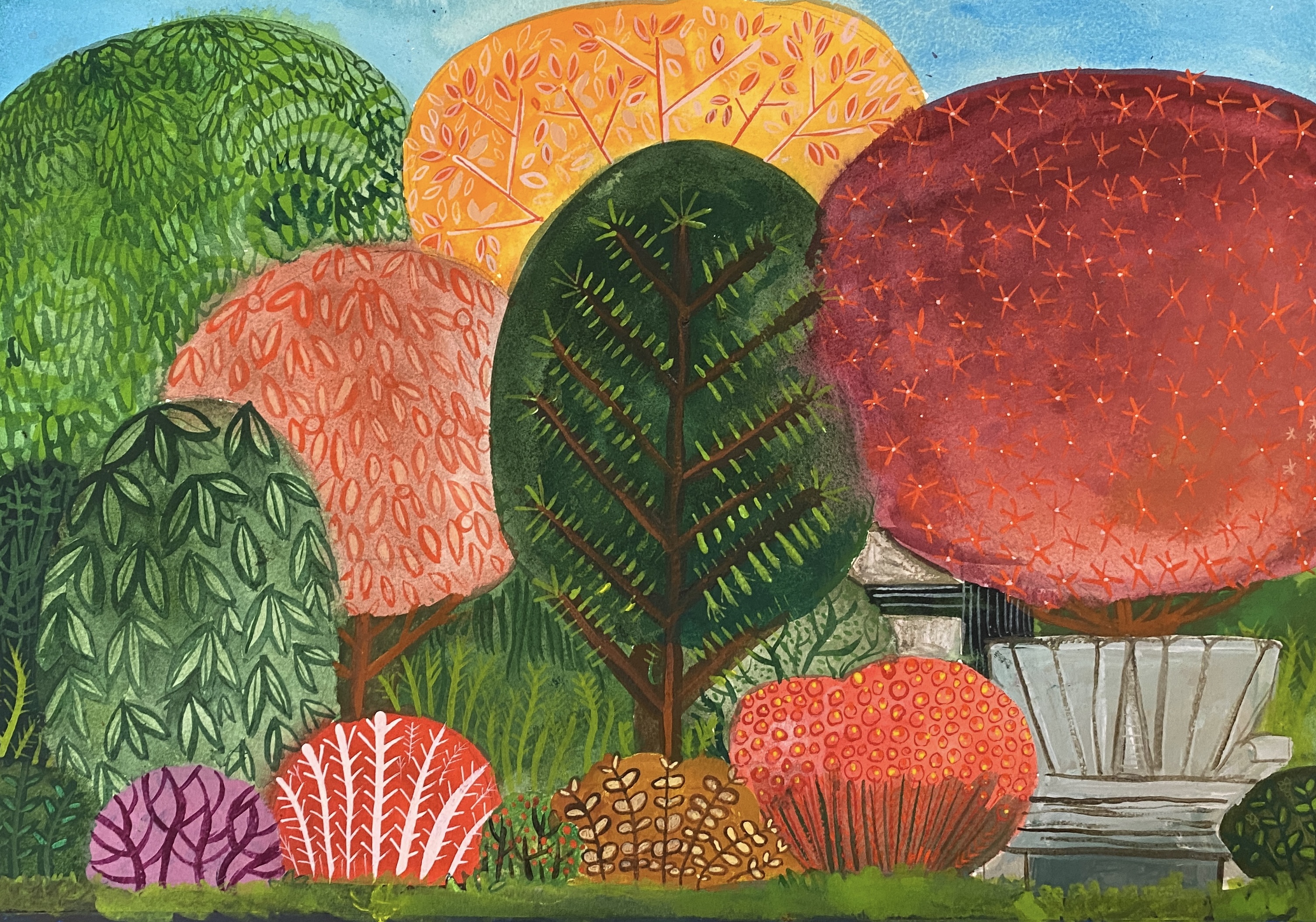
Back, inspired by the art we did see, Axel drew one of the many pine trees by our house.

Pine tree with mosquitoes

Coffee, hockey and orange shears

It was only a week ago that we arrived in Finland. It seems eons ago. We have explored Turku, did the archipelago trail, ate salmon, peas, baby potatoes and strawberries every day, and drank liters of coffee. tried out the local gin from Nagu island as we sat on the balcony of our home, on a warm night with our We enjoyed gin tonics, overlooking a large field of some very green grain (barley? Rye?). We also learned a few Finnish words thanks to Google’s translation app that you can even point at the inscrutable long words on a label or sign post (like to find out if we can park legally).

We learned a bit about the Baltic Sea trade centuries ago and watched the Fins, of any age, enjoy their very short summer. We encountered only a few bugs (and all those in one single place), experienced a heat wave (Lapland’s temperatures were 20 degrees (F) above the usual 66 degrees at this time of the year) and we had nonstop blue skies and temperatures in the upper 70s/lower 80s. Warmer and bug freer than we had expected.

We had some idea that we would be doing a walking tour of the city but it was hot and Axel’s back is hurting, and we spent an hour at a hypermarket to find replacements for the Nespresso coffee we used up (and then of course had a cup of coffee). By the time we were done it was lunch time and we found the perfect place overlooking the river Aura and watching the Sunday boat traffic go by while munching on fried baby potatoes, and a particular kind of Finnish rye bread that accompanied our trout salad and steak tartare. By the time we were done with that the afternoon was halfway done – how time flies when you are having a good time. We strolled down river, watched a street hockey tournament in a blow-up arena, had licorice ice cream and decided it was too hot for the city and headed for a beach where we watched more Fins enjoy the cool waters in between the Gulf of Bothnia and the Baltic Sea.

Back home we had yet another salmon and potato meal. On Monday we visited Fiskars (yes, of the iconic orange shears). We had coffee (of course) at a lovely place by the small brook that transects the town and learned that the owner is from North Carolina, lived in Saint Petersburg, somewhere along the way met his French wife and, when the pandemic started, escaped the city and settled in Fiskars. We had intended to visit the museum that showed the origins of the orange shears (ploughs), but we got sidetracked by a wonderful set of art exhibits that included the results of a competition to make a small house no bigger than 30 square meters (some were even smaller). It said you could spend the night in one of them but we didn’t bother to find out how that worked.

We had another fabulous lunch, visited the shops with their very Scandinavian designs, resisted the urge the buy stuff, and then drove through endless deep woods over backroads to Hanko. This is the place from where many Finns emigrated to the US. Hanko, like all of Finland, has a very twisted history when it comes to its relationships with Sweden and Russia. Apparently the Crimean war played a role but we could not figure out how. The place is known for its large villas that were built by wealthy Russian industrialists, not quite as massive as the cottages in Newport but grandiose Victorian wooden buildings nevertheless. At some point the Fins were driven out of the place and a garrison with 30,000 Russian troops moved in and left the town in shambles after they, in their turn, left.

The drive home was long, two hours, and we realized we should have arranged lodgings in one of these towns before going to Helsinki on Friday (a 200 km ride). Once again we found the roads empty and we could drive at the maximum speed all the time. We had been warned by our hosts that there are cameras everywhere that catch you when you go over the speed limit. Conveniently, big signs with a picture of a camera warn you (and Waze also tells you where they are). We stick to the allowable speed limits religiously (more so than we do at home). Driving west and northwest we had to deal with a very bright sun blinding us all the way home at the late hour of 10:30PM.

A stroll back in time

Turku hosts an annual medieval festival with 100s of people in period costume enacting various activities that presumably took place when Turku was an active trade port on the Baltic Sea. It was yet again a very hot day and I felt sorry for the actors in their outfits that looked a better fit for lower temperatures. Yet they were all very good natured and patiently explaining to people what they were doing. After seeing very few people during our first week in Finland we suddenly found ourselves in the midst of 180 thousand people who had all flocked to this highly anticipated annual event.

We have been eating seafood pretty much all the time, but when Axel saw the wild boar (or was it a pig?) on a spit, he couldn’t resist. The meat was served on a birchwood shingle. I continued with fish and got a birchwood plate with tiny small fry with garlic sauce. While we were eating the bishop came by (he looked very much like Sinterklaas) and the costumed people ran towards him and fell to their knees to receive his blessings.

We tried juniper and birch beer (no alcohol) and then the real artisanal beer that was brewed in a trough filled with hay, juniper branches and other naturals that worked as a filter. Because real beer was served the area was enclosed and a guard make sure no one escaped before their paper cup with beer was emptied. Some of the costumed people drank their beer from wooden tankards or horns.

All around the central square professional actors and volunteers in their period costumes demonstrated various artisanal occupations. There was a place for the children with traditional kids games and then there were the usual craft booths selling the kinds of things one sees at any craft fair in the US: woodcraft, leathers, jewelry, textiles, etc. The only thing we would probably not find at a fair back home would be the Minsk convent booth with its ornate carved boxes and combs. That’s when you realize that we are very far east.

After a bad night in our hot hut on the island the night before, the slow stroll along the booths-filled streets of Turku, and a quick tour through the museum with its remains of the old medieval town of Turku, had exhausted me. We plopped down at the banks of the Aura river at the Art café for a restorative cuppa.

For dinner Axel made open faced salmon sandwiches on a particular kind on the ubiquitous rye bread that a Finnish colleague of mine had recommended. For dessert I had made a rhubarb-strawberry compote. For the first time in days I collapsed while the sun was still fairly high on its downward arc (8:30PM). This meant that I woke up with the sun at 4 AM.

We are at the halfway point of our trip to Finland.

Island hopping

We completed the archipelago tour with an overnight at the edge of an island where a ferry was to take us further north the next day. After our splurge the night before we reserved a hut, happy to find a place at all, and not paying much attention to the details of our accommodation. Inexpensive, we thought.

As it turned out the ‘hut’ we reserved was a charming rustic one room hut (indeed) with four bunkbeds, a miniature kitchen and a porch. No toilet (ouch). Only the tiny window in the back of the hut opened and had a screen, the first screen we saw on a window since we arrived in Finland. We soon understood why. There were mosquitoes, midges and large meat eating flies. Unfortunately the large front window did not open and so there was no air moving in the hut, this on the hottest day so far (31C). I was reminded of sleeping in one star hotels in the Sahel, and that a good part of the world population lives in those conditions night after night. We have gotten so spoiled by AC. And so it was an endless uncomfortable night.

On the archipelago trail

The next morning we lined up for the ferry to make sure we got on as it would only go 4 times a day. On the 1st of July Finland’s summer tourist season starts in all earnest. So far we had marveled at the empty roads and restaurants. Compared to New England, it still feels very empty.

There were more ferries to hop from island to island. The next ferry, like poorly aligned traffic lights, wasn’t going for another 3 hours. Luckily there was a small coffee shop (these are ubiquitous here as the Fins, apparently, drink more coffee than anyone else) a few 100 meters from the embarkation point. Even better, there were open faced salmon sandwiches which I washed away with a spruce root Prosecco from Lapland. Walking back there were sweet wild strawberries growing along the road.

All along the way we shared the road with bike riders. Apparently the 250 kilometer archipelago bike trail is a popular summer outing. We saw fully loaded bikes with people sweating in 30 degree heat over undulating roads. It would have been a good reason to have an e-bike but we saw very few of those.

Once we had completed the trail in the comfort of our air conditioned car, we returned to the familiar surroundings of our Finnish home and collected the usual ingredients for dinner: gravlax and cold smoked salmon, fresh peas, freshly dug potatoes and strawberries, all bought by ‘the liter.’ We will probably be tired of this dinner when it is time to go home, and will have to make do with the US version of it all.

Exchange

We are on one of the islands in the archipelago in Finlands’s southwestern corner. It reminds us very much of Maine, except for the signage with long words that contain lots of vowels. The Finnish summers are short and intense with daylight that pretty much lasts throughout the night. It never gets dark. It is lovely, now, but the price paid for that is the opposite during the winter, much darkness and very little light.

We have exchanged our home and car with a Finnish couple for two weeks. Most of that time we are spending near the old capital of Turku, an old sea port that faces Sweden. We are not only exploring the country side and the city of Turku, but also Finland’s history and its complex relationship with its mighty neighbor. And then of course there is the cuisine: fish, in particular salmon and herring prepared in countless different ways, baby potatoes, fresh peas, countless varieties of the sweetest strawberries (so many hours of daylight makes for the most amazing berries), delicious pastries and all things licorice (ice cream, gin, aquavit, sauce for over ice cream).

When you exchange house and car you end up saving much money which can then be used for splurging on lunches (our breakfasts and dinners are made at home) and occasionally on a hotel when we make an outing that takes us away from our base. We’re right now on the archipelago trail, going from island to island, near the mainland by bridge, further into the archipelago by ferry, mostly short and free, sometimes longer and paid.

Even though it is summer and the schools are out, compared to New England what we have seen of Finland so far feels empty. Hotels and B&Bs have rooms available on a very short notice, traffic is sparse and we have yet to experience a traffic jam. Even on our ride from Helsinki to Turku on the E18 (which connects Saint Petersburg with Kristiansand in the south of Norway) we saw very little traffic, making us wonder where everyone is. But then again, everyone means only 5.5 million people (by comparison, Massachusetts alone has 6.5 million people). Still, in this summer paradise, where are the people? With summers this short and sweet, why would you want to go anywhere else?

The best part of this vacation is the continuous downtime, something I have not had for years, maybe even decades. I am not checking email, doing my portable jigsaw puzzles, and reading actual paper books. As a result I fall asleep easily, sleep well (even though it never gets dark), wake early and go to bed late.

Planetary inflammation

Over the years it seemed that more and more people have woken up to the dangers we have been creating for ourselves: the toxins in our wheat and fields, the processed food, the pollution of water and air, the increasing number of traumatized people, toxic leadership responsible for so many geopolitical catastrophes in the world.  There appeared to be a recognition that we can no longer solve our problems by thinking only of our ourselves, our needs, wishes and wants, because whenever we did, our solutions simply created more problems (mostly for others). Our interdependencies are now more obvious than ever before.

And so, I thought we were finally on a path to planetary peace. I have seen the momentum built up over the past decades (actually, since the end of WWII).  So many individuals and groups were recognizing that not doing anything was no longer an option, and then set to work with others to pursue this path, buoyed by the limitless energy and idealism of younger people. And then Putin made the U-turn. It wasn’t sudden by any means, he had been moving over to the inner lane for a long time, but there it was, bombs and all. Instead of planetary peace we now have planetary inflammation. 

I keep thinking of Mr. Rogers’ ‘look for the helpers.’ For any of the world’s catastrophes (whether self-generated or befalling us) I see an overwhelming positive response. Whether it is food or geopolitical conflict, there are more people standing up for the voiceless, and recognizing our responsibilities towards the 7thgeneration than those who seem determined to erase the prospects of a livable future for all.

For two years now we have been trying to consummate a home exchange with a couple from Turku, Finland.  Last week they wrote to us asking whether we would cancel (once again) our exchange, fearing to travel to Finland, the country with an 800+ mile border with Russia. Other exchangers, from Colorado, had already canceled, and they were wondering about us. “Not unless WWIII breaks out,” we decided. Finland is of course a special case. It was exactly 82 years ago that the Finns learned it could not count on anything as close to a united Europe we see now. On March 12, 1940, they signed an unfavorable treaty with their big and powerful neighbor that included ceding a part of their land (Karelia) and allow the construction of a Soviet naval base on the Hanko Peninsula.

We went ahead and bought our tickets to Helsinki for June, counting on wisdom and altruism to prevail in the world. 

This morning we held our usual Music & Imagery session. We meditate and go ‘inside,’ then return with whatever we found there and commit it to paper. Although the technique is used in therapy (by the ones who lead the sessions) for us it’s not a therapy session but rather like a folk dance with a group of women (some in Quebec and others in Massachusetts) who have become very special to each other. 

We share our experiences of the world as it is. Today it was a rather depressing conversation. About Ukraine of course, but also the pandemic and the ones that come after, and then I throw antimicrobial resistance on the fire and whoosh, we’re all depressed. And there is more, that article in the New Yorker about destitute Afghan women sitting in the middle of the road in wintry Kabul, babies clenched to their chest… It’s too much to bear. All day long I walked around with a large brick in my stomach (or lungs) that got in the way of breathing. And then I recognize and marvel at my luck and privilege.

One of the things that led to my depressed state yesterday was listening to an interview of our friend Jerry Martin about the link between meat and pandemics. I told Jerry that he managed to get to simplicity on the other side of complexity, rather than simplicity on this side of complexity. The message is very disturbing although it had one high note at the end. He reminded us that we were not totally unprepared for the pandemic: it was after the 2005 avian flu pandemic that researchers started to work on MNRA vaccines which has allowed many more people to survive COVID-19.

The ones who leave

About three decades ago, the UN’s High Commission for Refugees (UNHCR) launched an advocacy campaign that included large posters with the faces of famous people. I had one on my wall with the iconic image of Einstein, and underneath the words “Einstein was a refugee.” But at that time the plight of refugees was a rather abstract idea for me. I didn’t know any people who had had to leave their home and everything behind for well-founded fears.

After the Taliban took over the government (if that’s what one could call it) in Afghanistan, the idea has taken on human proportions. In June or July last year a senior official in the Afghan government had contacted me, desperate to get out and needing help to do so.

I had gotten in touch with group of committees lawyers working with a prominent law firm in DC who were working (pro bono) on the application for Humanitarian Parole for him and his family. They had reason to fear the Taliban. I was pessimistic about their chances, due to the sheer number of applicants for this kind of visa and its limitations once in the US. Besides, he had not been able to leave the country and was essentially on the run, not being able to live with his family. I had been in communication with him since last June following the harrowing story.

A few days ago I received a surprising message via WhatsApp that this family got out of the US queue and made it safely to the UK, thanks to a connection to someone high in the British Defense hierarchy. The Brits can rejoice as this family will enrich them. In the US we have lost out. The political rhetoric has led to a common narrative that portrays refugees as a burden. In this narrative refugees are not just seen as a burden but treated as one, creating a self-fulfilling prophecy.

About a decade ago my brother introduced me to Omar, a young Dutch/Afghan man, while I was visiting my family in the Netherlands. At the age of 7 he had arrived in the Netherlands in the early 90s as part of a previous stream of refugees from Afghanistan. Now in his mid-thirties he has become a partner in a prestigious law firm and a full law professor at one of Dutch top law universities. He has found a way to enrich the Dutch and be enriched by them. He also pays taxes, probably quite a bit. If you can read Dutch, here is the interview with him.

Refugees make us better, improve the gene pool, contribute to society, and teach us about diversity. They always have. Diversity, as we know from nature, improves rather than decreases our chances of survival. Refugees also teach us about things we admire here in the US: courage, perseverance, resilience and faith. They have leapt from the edge, something that most of us never have to do. We ought to improve their chances of a safe landing rather than pulling away the safety net and then scold them for being a burden.  I am grateful to the many people and organizations that hold the safety net in place for the Afghans that made it here. We should consider ourselves lucky to have them.

Making bread

For about two years now I have been baking our own bread.  In April 2020 I took an online workshop on bread making that was organized by our local library. The title of the workshop appealed to me: five minutes a day no knead bread. Up till that time I had assumed and accepted that I could not make bread. All my effort resulted in bricks, dense hard loaves that were basically inedible.

Ever since that workshop I have been wildly successful in making my own bread. I have developed variations to the master recipe, experimented with different grains, including the spent wheat from Axel’s beer making. There are only four ingredients in the basic recipe: water, salt, yeast, and flour. No preservatives, so you know what you’re eating. Because of that the bread doesn’t stay “fresh” for very long. But that’s never a problem because it tastes so good.

We have some division of responsibilities in our household: I make the bread an Axel makes the beer.  After my mishap early January, breadmaking became his responsibility since it was impossible for me to do with my right hand in a cast. 

And so, it was time for Axel to learn the trade. I tried to explain the different steps. One of the important things to do once you have taken the bread dough out of its container, is to quickly “cloak” the dough to keep the gas bubbles inside. This produces the holes in the bread. 

Apparently, my explanations were not good enough. Goaded by my, “you should do this only for 20 to 40 seconds,” Axel was frantically turning the ball of dough in his hands, not understanding where the ‘cloak’ was supposed to come from. The cool refrigerated dough became more and more sticky as it warmed up in his hands, sticking to everything as the seconds ticked by.  He didn’t understand the “cloaking” part, not the theory and not the practice. We watched some YouTube videos, but because the hands of the baker were so fast and the clip so short, that even playing it over and over did not get the concept or practice across. 

This morning Axel announced that he will master this, seriously! If we don’t want to buy bread, he will have to be the bread maker because I’m still in a brace until the middle of February.  His second attempt was already much better: it was a thin loaf that was so delicious that we ate the entire thing for lunch.  When I come out of my brace in three or four weeks, we will be able to share bread making responsibilities and I better get started on learning to make beer.

Creating

I have been upgraded (or downgraded) from a plaster cast to a plastic brace with a lot of padding and Velcro. The break is healing but not yet fully healed, hence the brace. My fourth and fifth digits still need to be immobilized for at least 3 weeks.  

It remains difficult to write by hand. This morning one of the members of my Music and Imagery group suggested that I do my drawings with my left hand. I did. I even wrote the titles of my drawings with my left hand. Axel mentioned that this will be good for my brain, forcing it to rewire my writing circuitry. I think my brain is generally in good condition, what with all the reading and studying I do. But I should probably have started to practice writing with my left hand several weeks ago. Right now, my left-handwriting looks a bit like the writing of my six-year-old granddaughter. In the coming weeks I will be doing several interviews over Zoom. I don’t think note taking with my left hand will be possible quite yet. I will have to record.  Luckily, technology will help me with the transcribing.

Talking about technology, a few days ago I attended a demo of a platform called Gatherly. I would like to use this with one of my clients that is embarking on a (mostly remote) strategic planning process in the coming year. I am so impressed with the young people who are creating these amazing platforms (Wonder.me is another among many) that allow us to be together-apart in ways much more interesting and fun than Zoom, Google Meet or MS Teams.

The pandemic has forced us to go inside because we could not go outside. This appears to have triggered tremendous creativity and innovation. Not just in the technology field, but also of art in its many shapes and forms. There are amazing pieces of music being composed. There is so much art rising out of pandemic despair. 

Although I am not much in pandemic despair – we are weathering the pandemic under extremely lucky conditions—and I’m not creating new things in an artsy way, my brain is very busy with sense making.  I am reading and studying a lot, absorbing other peoples’ great ideas and thoughts about teams and group processes, converting them into approaches to deal with challenges my clients are throwing in my lap. I am going a bit out on a limb, especially about team coaching. My next, more advanced, team coaching training won’t start until another two weeks from now and practicing my new craft under supervision is even further out in the future. Fake it till you make it?


December 2025
M T W T F S S
1234567
891011121314
15161718192021
22232425262728
293031  

Categories

Blog Stats

  • 136,984 hits

Enter your email address to follow this blog and receive notifications of new posts by email.

Join 76 other subscribers