Archive Page 262

NicaBoca Glory

On Wednesday night Cabul and I were eating our NicaBoca Glory desert (pink ice-cream with crushed peanuts and chocolate sauce) while sitting in a Caribbean looking restaurant, looking out at a starless night with a giant flaming oil rig in the far distance off the coast. (Could this be a real burning platform?) The NicaBoca Glory was a special indulgence to celebrate our achievement. Less than a month ago Cabul had asked whether we could pull off what we just pulled off. I had said yes but only if he came along. And so we did.

The workshop ended exactly at the appointed time and in the envisioned high spirits. All through the morning the facilitators had been facilitating and I had been busy thinking of loose ends that required my attention as well as preparing the materials and photos to be burned on a CD for each of the teams and a few high level officials. Outside the conference room Cabul and Jennifer were preparing for the ritual of handing out the envelopes. This is a euphemism for money. Participants get it on the last day so they don’t cash in and leave on the first day. Frankly, I would have preferred that as it would have separated the corn from the chaff, or at least the really light chaff would have been blown away. When people have no interest in coming other than the handout they receive I’d rather not have them in the room. On the other hand, now that they stayed, we may have planted some seeds.

The preparation of the envelopes required that Cabul make several trips to the local bank which was a severe test of his patience. In this part of the world banks are not there to serve you but to serve themselves. If you expect anything else you are bound to get frustrated. I am very glad that it was Cabul and not me who had to deal with this.

Once the closing speech was made the feeding frenzy started, both figuratively (the envelopes) and literally. Countless drivers came out of the woodwork to claim their envelope and a free lunch. The plan was for the facilitators to lunch together and reflect on the entire workshop and look ahead to the next. This part did not go according to plan. Some of the facilitators returned to the training room to announce that all the food was gone. How 40 people can eat that much food so quickly is a mystery but they did. This did not help their mood; several of them were anxious to get on the road. The discontent came on top of other grudges that were wrapped in verbiage about mismatched expectations. Some of it was our fault and some of it was about the meaning of ‘expenses.’ Unfortunately it was our new team leader’s organization that was seen by all as the miser. I felt bad because such things can create ripples that affect their work here. I am not sufficiently familiar with this country to know whether grudges like that hang around for a long time or are quickly forgotten.

It was a tricky situation that showed how quickly a sense of collective inspiration can be completely eroded by mismatched expectations, or, more seriously, by more basic needs. It also shows that the collaborative spirit was still a very thin veneer. It does make one think about Maslow’s hierarchy of needs. The situation asked for leadership and that is what I then saw in action. The team’s new leader stepped up to the plate, got the anger and frustration out in the open and facilitated a conversation until agreements were reached in which we all, not just me and Cabul, had a role to play. We ended up not doing any of the thorough debriefing I had hoped to do because the last conversation used up all our remaining energies.

I committed a final faux pas by hugging instead of shaking hands. I could tell from the bodies stiffening under the hug that I had crossed a boundary. It was time to part company and go our way. Cabul and I quickly packed up our own stuff and left the hotel even though the restaurant had started to prepare more food and announced, by way of our driver, at 4 PM that lunch was ready. But by then we had just completed our debriefing with the Regional Health Director and preferred to continue down the road rather than turn back for what would be a heavy starchy lunch that I could do without.

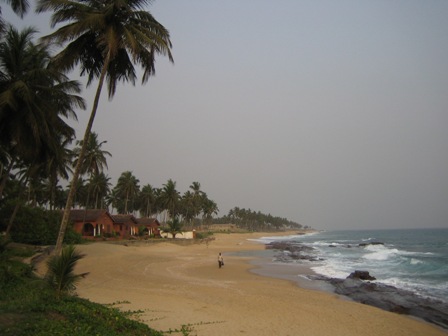
After one more attempt to extract money out of an uncooperative bank and a finicky ATM (we did succeed eventually) we were off to our evening and morning of relaxation at the Anomabo Beach Resort – I kept calling it the Anaconda Beach Resort – where Cabul had made us a reservation. It is a hitchhikers and campers place on the ocean, simple and lovely. img_1385.jpgWe took the most expensive rooms (45 dollars) for our night of luxury and had one big bottle of beer each, plus that NicaBoca Glory ice-cream desert.
The crash that wasn’t

Computer viruses are more rampant in West Africa than anywhere else. I don’t know why but my computer constantly gets infected by the pen drives (data sticks) that people use to exchange files. May be it is because many people travel with pen drives or external hard disks and use them in internet cafes. It is the computer equivalent of having sex with strangers in bath houses. So when someone gives me a pen drive in this part of the world I am particularly careful. Yet somehow one virus slipped into the system. Symantec discovered it but told me there was nothing it could do. I had just finished reading Richard Preston’s The Hot Zone about the Ebola and Marburg virus and it felt a little bit like catching one of those. With some sense of dread and foreboding I was waiting to see if this infection was going to be fatal.

And then it happened, the sluggishness, a reboot and then all my personal settings disappeared. Everything familiar on my desktop had vanished. Instead I saw the solemn grey Dell screen that is standard in the new computer. While all this was happening the one facilitator who I had not seen in action yet was doing his session. I needed to watch him. I tried not to panic.

What happened next was quite similar to my reaction 6 months ago in the other crash. The feelings generated by both crashes were remarkably similar. There was a moment of bewilderment, followed by surrender – a recognition that this was an event entirely beyond my control. And then there was an intense effort to concentrate on the here and now and trying not to think of what lay ahead; while life went on in the background. Only for me had the foreground and background traded places.

I alerted Cabul to my predicament and he started to Skype chat with colleagues in Boston for help. He was my first responder and was able to stop the wave of panic by finding everything else that was not on the desktop. That was one big sigh of relief, something similar to when the doctors said, “You will all be OK.”

And then came the period in which everything that was simple before and that you took for granted no longer was. Like the names of people you email regularly that automatically complete themselves when you start typing; or the way the desktop was organized; or Outlook that needed to be installed and was empty at first, taking hours to fill up with megabytes of content, or all the electronic Post-It Notes that I had on my desktop with things I wanted to remember or be reminded of, such as codes, numbers, quotes, book titles, websites, etc.

Several hours passed and I started the long work of computer rehab to re-build everything that had to do with personal settings until I had no more energy left. Back in my room I restarted my computer again for reasons I can’t remember anymore. Then there was that moment of suspense, staring for what seemed like eons to the empty blue blank screen, and then suddenly, there was the old desktop again with everything on it, as if nothing happened, even the files I had been moving from one place to another were where they are supposed to be. As if it was all just a bad dream.

Rythm

There was rhythm yesterday in our conference room. And one rhythm set of another and another. Before we knew it we had a chain reaction.

It is delightful to work in a context that is not big on protocol. We shove a table to the front of the room. It had some nice Kente cloth (not the real thing, a print) pulled over it which set it apart from the participant tables that were covered in a sort of fancy bed sheet with blue lacy corners. The other thing that set it apart was of course the plastic flower arrangement, a staple in any hotel that is worth its salt. If you have plastic flowers on your table, then you know you are important.  I have seen people enter a workshop room and scan it for the plastic flowers. It is like a beacon that guides people to their proper place.

The regional director, the doc from the central level and I sat in back of the ‘head’ table and each said their words of encouragement and support and then we set to work.

I rarely ventured out from my seat in the far left corner where I watched and occasionally took notes for the feedback session that we had at the end of the day. This is truly a very experienced and accomplished group of facilitators; a sharp contrast to government officials I have worked with in other parts of the world who have a habit of telling people what to do. They tell first and ask later, if they ask at all. Rhythm is usually lacking.

By lunch people remarked, in a surprised sort of way, that there had not been any powerpoints or people lecturing them. As the day wore on the surprise increased; people participated; people were not dozing off; people were full of energy. It always amazes me that after 25 years of exposure to American or British or German or what not experts who do training of trainers, having what I would call a normal engaging inquiry into people’s realities coupled with an orientation towards some simple frameworks is so extraordinary that people notice. What has everyone been doing all these years?

It is of course all in the structure of the design. Interestingly Axel wa also thinking about structure which he mentioned in an email just when I was thinking about structure. Structures can be constructive and destructive. This applies to any structure in our lives of course. If you design it well, the action will follow in predictable ways getting exactly where you want to go. If you design it badly, the structure will constantly pull you off track and you spent all your energy amaking course adjustments. You may never make it to your destination.

Late in the day the facfee beast reared its ugly head. I have come to expect it and it was nice to have Cabul with me to deal with it. Facfee stands for facilitator fee. The entrenched belief is that money motivates and without it there will not be movement. It is so entrenched, all over Africa, that it has become a self-fulfilling prophecy.

Until a year ago I had never heard of this facfee thing. It is a payment in cash to people to do what is considered ‘in addition’ to their regular work. It is an escape hatch from contracting which can never be done with public sector employees as per USAID regulations.  Before when we used to do the facilitation ourselves, it wasn’t an issue because the government officials we worked with were participants not facilitators. They received the per diem which, in some countries, can be a nice salary complement, especially if you go to many workshops and they last long. With the trend towards short workshops (one or two days), this is not longer so interesting. And with the trend towards local facilitation, this becomes an issue. With private sector or NGO people we contract, either directly with them, as independent consultants or through their organizations. Of course this time all of this is a bit shaky as we organized the event over the holidays and, not knowing the cast of characters, we arrived without anny contrtacts in place. We did not want to establish contracts with people or organizations we did not know. Cabul has to iron this out in the next few days before we head home so that we can have the proper contactual arrangements with everyone. As for the government employees, there is a broken record, stuck in the groove that says ‘not allowed.’ We’ll see where that takes us..

Halfway

It seems that every time my mind thinks that my body has changed (for the better and for good), my body changes its mind. My shoulder pain returned and I woke up again with numb hands. May be this is simply a call for patience on the day of the half year anniversary of our crash.

So it has been 6 months and the doctors gave us one year. We are thus halfway. The second half will not see the dramatic improvements of the first half, but rather a slow and steady return to our old selves. Or maybe we are simply getting used to always having some pain somewhere in our bodies. Sooner or later that was bound to happen anyways.

Cabul and I left our Coconut Beach paradise spot (owned by a local politician we discovered) around noon time, after a last swim and another breakfast with a view. We checked into our workshop hotel in Cape Coast a little later. The hotel is built on a hill between the Ghana Health Services Regional office and the Ghana Education Services office. It overlooks the ocean, like everything else here does. The hotel is called the Sanaa Hotel. This has nothing to do with Yemen. Sanaa is the local name for ‘House of the Treasurer’ which refers to this function within the Tribal Council; once the treasurer lived here – he does not own the hotel as I had assumed

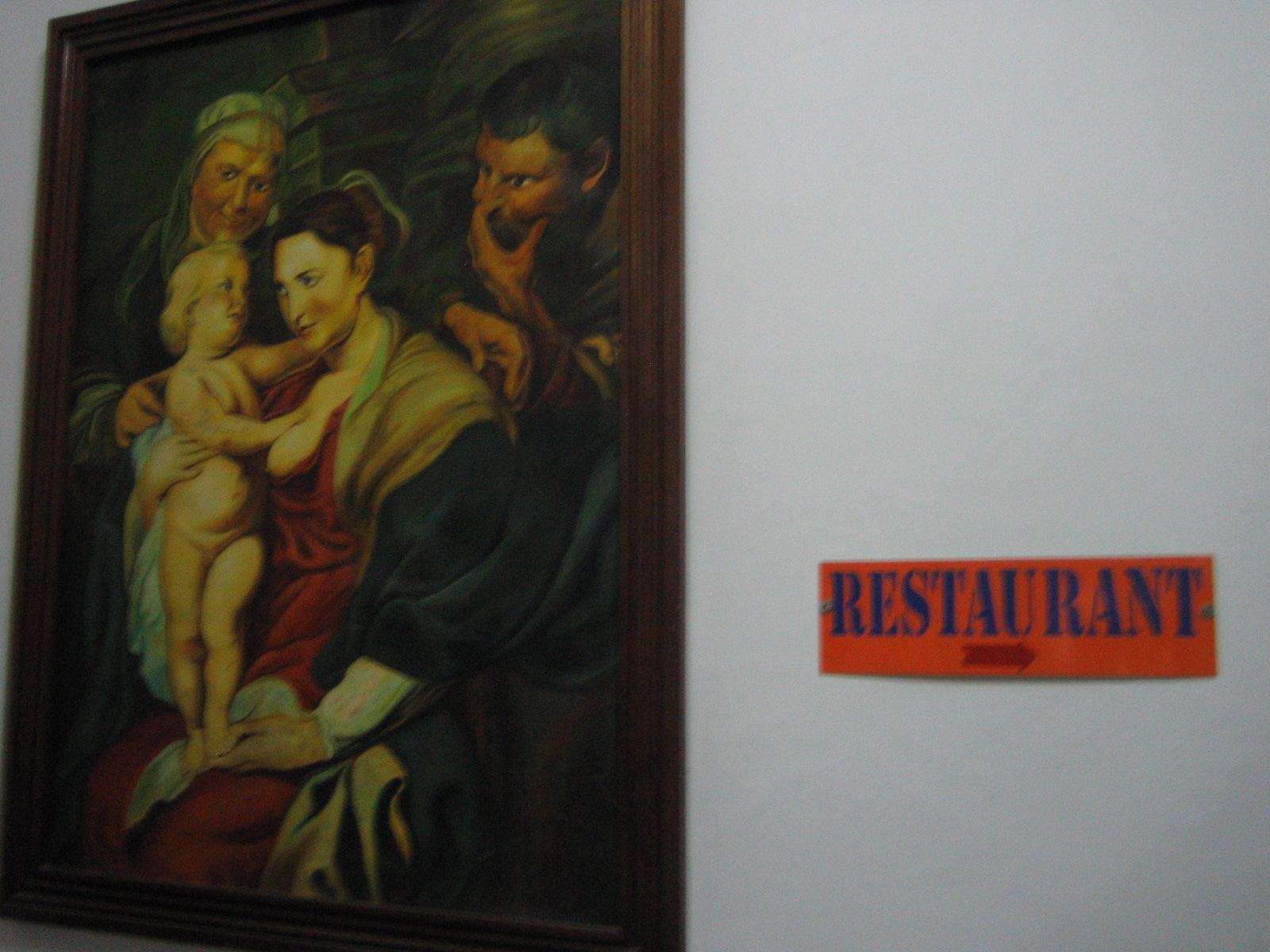
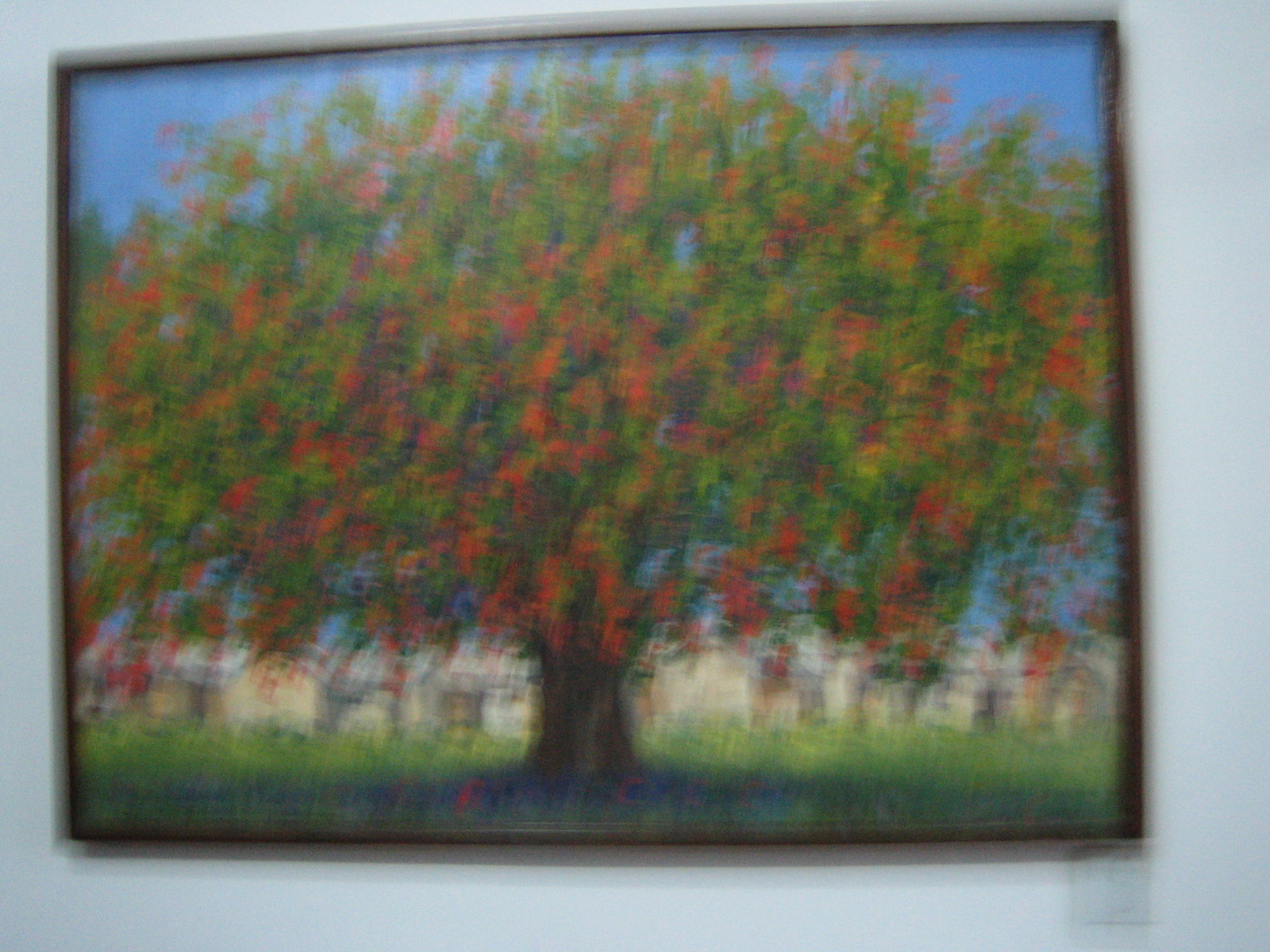
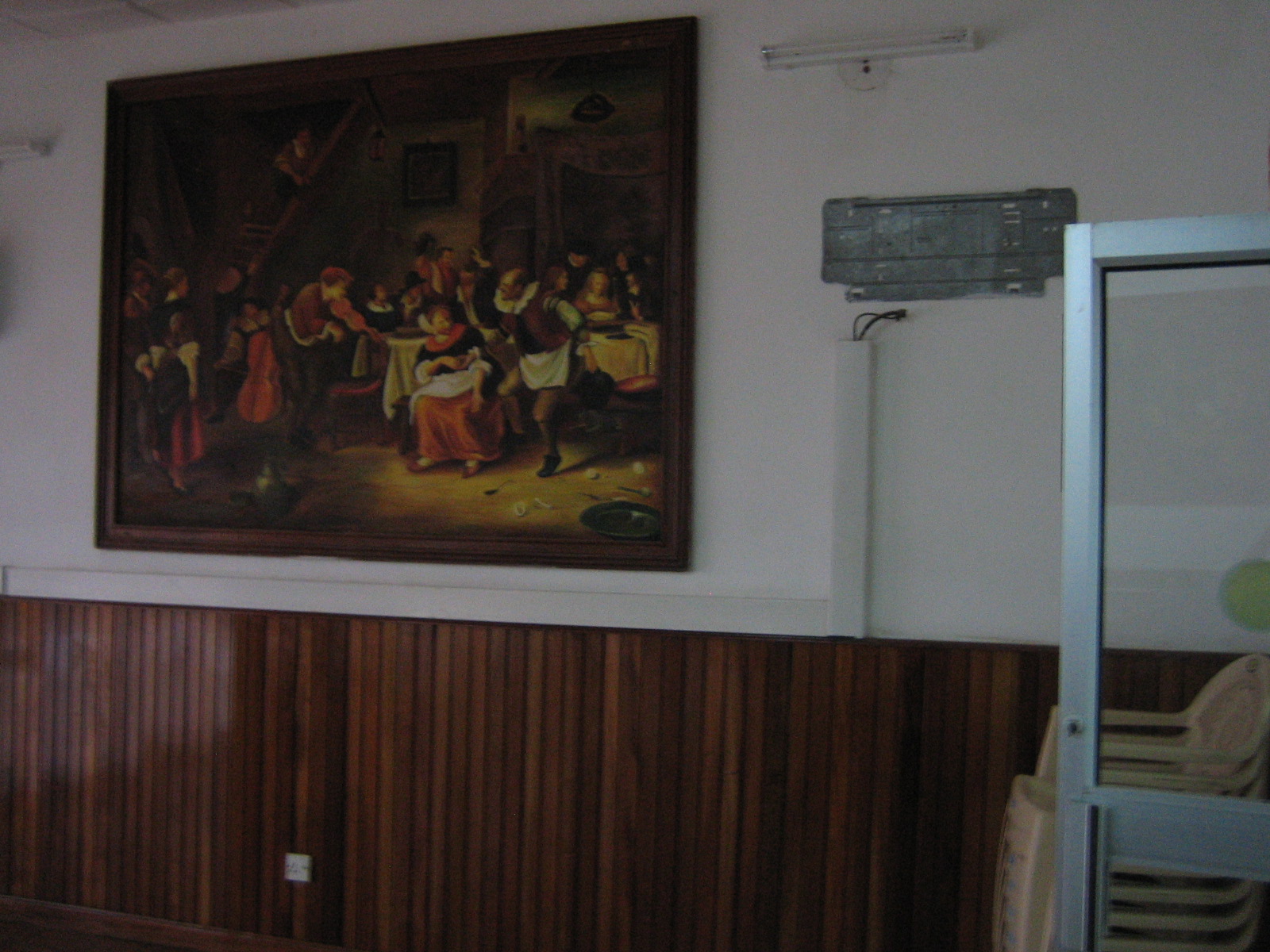
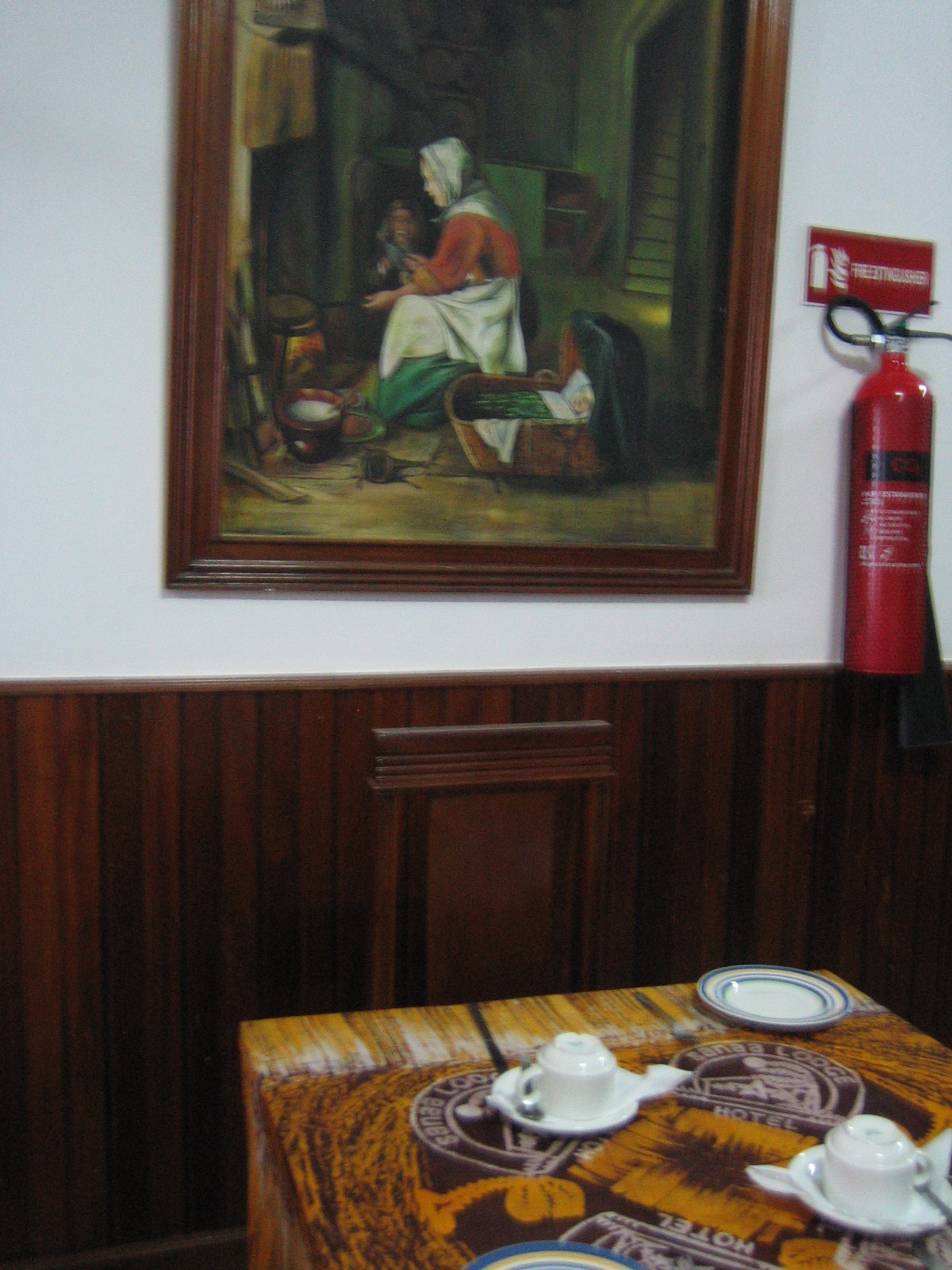
Inside is an eclectic assortment of art on the walls. There are many large hand painted (oil) reproductions of old Dutch and Flemish Masters. img_1303.jpgimg_1306.jpgimg_1308.jpgFrom a distance you think you are stepping into a Dutch museum but when you get closer you see that the faces and some other details don’t quite work (and the rest of the décor sort of gives it away). Nevertheless I can see the work is done by serious artists who studied the big masters by copying them. More power to them; I wouldn’t even have dared to try. And then there are smaller drawings of variable quality, sketches and watercolors that adorn the many hallways. And in the midst of all this hangs a most extraordinary painting of a flame tree that I covet. img_1307.jpgI have seen another beautiful painting by the same Ghanaian artist in the US embassy in Accra. I wouldn’t mind clearing an entire wall for his art in my house. I hope to visit a local gallery on Friday to see more of is work but I have a feeling that his art will not quite fit into my purse.

By 4 PM most of the facilitators had arrived and we spent the next few hours going over the program and assigning roles and responsibilities. Everyone picked sessions they wanted to facilitate. There was none of this looking at me and hoping I would do it all with them observing. They all wanted to throw themselves right into the fray. It is already their program and I have to let go of it much earlier than I am used to. It is really wonderful to watch the energy and commitment. My role will thus be observing and giving feedback. It is a good model since I will not be there anyways for the rest of the program that is spread out over the next 4 months.

After dinner everyone prepared their sessions and flipcharts and then one by one they retired. I was the last person out of the conference room. When I turned the air co and lights off everything looked ready and perfect for the start of our workshop on Monday morning. This has been the easiest and most painless launch ever of a leadership development program.

Tourists

On Saturday morning Cabul and I set as out as tourists. ADRA had made driver Charles and an ADRA car available to us in exchange for expenses, a very generous deal. We drove to Fort St. George at the end of the bumpy road into El Mina.

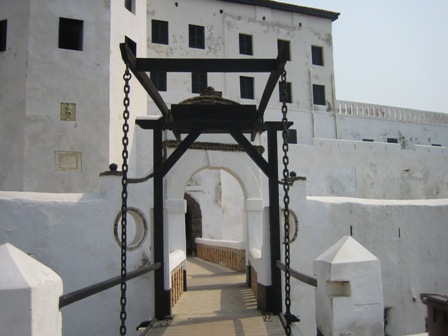
The Portuguese arrived here in 1482 attracted by vision of gold. They built a fort with a church inside it, as they did in many other places along the West African coast. The Dutch, their arch-rivals at the time, showed up in 1637 and kicked them out. They enlarged the fort with two moats and a drawbridge Drawbridge at St. George Fort in El Minathat has a distinct Dutch flavor. They turned the Portuguese church into storage space and made a more austere church in the main building of the fort, right above the female slave quarters, dark and filthy places where the women and men were held, separately, waiting for the ships to take them across the Atlantic.

The old church now holds an exhibit about culture, kings and the customs of the land. The list of kings goes back to 1300; the first 350 years seem more stable with kings chosen along the maternal line; the second 300 years favor the paternal line but there is much interference from the Portuguese, then the Dutch, and then the British. Kings sit on stools rather than thrones, and thus kings are stooled or destooled as the case may be.

As the guide told us delicately, the Dutch men, and the Portuguese before them, were without wives in these dangerous tropical lands and so they needed ladies. Thus, from time to time the miserable group of women was let out of their dank and dark dungeons into the courtyard. Standing in that very place I could picture how the governor, leaning out over a balcony two stories higher, would scan the crowd for his enjoyment. While he was doing this the blinds on the church windows across from him would be ordered closed. Clearly he did not want God to see him as he was preoccupied with his baser instincts.

If the governor could not make up his mind the guards used a Dutch rhyme that I learned when I was little (iene, miene, mutte). Our guide Richard recited it with the right intonation; the words were a little off, but may be it is because it was old Dutch, a language I never learned.

The ‘lucky lady’ was cleaned up by soldiers and given some food and sent up through a set of backstairs and a trapdoor to the governor’s private quarters, to be used as he wished. After he was done she’d go back down the trapdoor and held for a while on the floor below to entertain the officers who lived there before being discarded back into the mass of misery down below. Her only hope was that she conceived. Pregnant women were released. They could go home, a walk of some 1000 miles, or stay in town and become the mothers of a new group of notables. Their children had Portuguese or Dutch last names and were of light skin, which meant better in the social pecking order. They became the new elite. They are still very visible to this day al along the Southern coasts of West Africa. The Maternity Home has been restored and stands as a symbol of new life, in more than one sense.

The Dutch were driven out by the British in 1872. With the abolishment of slavery the place started to decline as a commercial center. Now, with the help of the EU and the Dutch government an ambitious restoration project is underway. Pictures of Dutch Crown Prince and his Maxima show the launch of the project.

After the fort we visited a similar imposing building but there the restoration and ‘touristification’ had not yet taken place. We were the only people there and had to wake up the ticket seller, sleeping on a bench in a stark naked room with only a transistor radio for company. We paid 2 dollars for a self guided tour as per the fee schedule posted on the wall but there was nothing to guide us; the place was in disarray with debris and construction material strewn along, bats and birds nesting in the turrets. They did not like our intrusion. It was a very short tour.

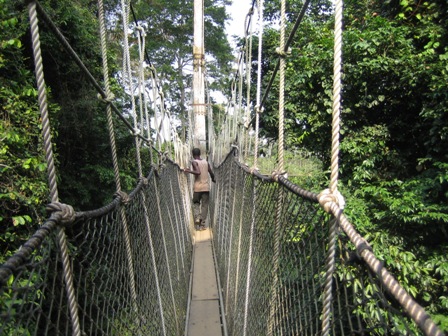
After lunch at the restored Bridge House, now a hotel and restaurant, we left for Kakum National Park. The park is about 35 kilometers inland, and has the only canopy walk in Africa, according to our forest ranger guide. We started our walk with buses full of Ghanaian adolescents, mostly church groups, and a sprinkling of foreigners. The walk up was tricky for me, uneven rocks and quite steep at first. But even I was in better shape than many of the young Ghanaians, so I understand the health minister’s preoccupation with ‘Mens Sana in Corpore Sana.’ Cabul and I were number 2 and 3 on the walk which consisted of 7 spans of 40 to 60 meters long that were constructed from aluminum ladders laying flat on the bottom of nets tied to ropes and with a plank over the ladder to facilitate the walking. Canopy walk in Kakum National ParkThe walks were between 11 and 40 meters above the ground. It was breathtaking to be so high up with the sounds of the forest canopy, mostly insects and birds. We were sufficiently ahead of the teenagers to not hear their shrieks of laughter and terror. We watched them later as they stepped on the first walk, the boys teasing the girls, the girls playing their damsel in distress role to the hilt.

Back at the park entrance I visited the exhibit which was nicely done. It was the first time I saw the Adinkra symbols used in ways I like to use them. Many are stylized representations from nature and it is graphic design at its best: the fern stands for endurance and defiance; the snake climbing up a palm tree stands for doing the impossible and 4 crocodiles pulling outward stands for unity. It gave me some more ideas for next week.

Breakfast with a View

cgbhview_sm.jpgI am sitting at a breakfast table in an open air restaurant that looks out over the ocean. I have a front row seat and watch hotel staff wash the Harmattan dust off the warped ping-pong table. Behind him, not allowed on the hotel premises but as close as is possible are young men in their Rasta outfits trying to sell trinkets to holiday makers. In back of them, just along the water’s edge, a few women walk in a line in and out of view with enormous piles of firewood and bowls on their heads. They walk fast, bare feet. And far off on the horizon I see the fishing pirogues, some with sails others with paddles or motors.

Yesterday morning we left Accra early. We arrived in Cape Coast and went straight to the Ghana Health Services regional office to make a courtesy visit and see the workplace of one of our teams next week. After that it was time for a little holiday as the Brits call it. One of the regional Office staff had booked us in a delightful beach resort, the Coconut Beach Hotel for Friday and Saturday night. Sunday we move to the venue for the workshop which is right behind the regional health office in the town of Cape Coast.

To get to our temporary quarters we drove through the old slave port El Mina, which reminded me of Zanzibar and other slave ports I have seen along the coast of Africa. The place was teeming with people. They are dwarfed by the two imposing buildings that we will visit today. One is probably the old governor’s castle, the Dutch were here in the 17th century, the other I am not sure about. We are going to visit the town today.

The resort is a few kilometers outside El Mina, at the end of a bumpy road that leads through a small fishing village. Small fish are drying on racks everywhere.

We bought access to the hotel’s hotspot access network. I had not expected it and later wished it hasn’t been there. Connecting to it became an exercise in patience and I gave up quickly and ended up sitting by the ocean and reading for hours. Against doctor’s orders I ordered a Pina Colada. It is the kind of drink you are supposed to have in places like this. It was heavenly. Cabul was more task-oriented than I and fiddled with his budget spreadsheets until the numbers came out right. Today he too is going to relax and we will be tourists.

Hillary

My dream about Hillary started with us passing in a parking lot. Hillary was on her way to her caravan (a large family car, the epitome of suburban achievement in the US in the 90s) and I was on my way somewhere.. As we passed she looked me deep in the eye, the way spies would do when they pass each other at a cocktail party and communicate through their eyes without talking. But then she spoke and it was something very personal that surprised me. It had something to do with a choice I had to make. I remember being surprised about the personal attention, as I assumed she was dealing in millions, not single, votes.

Later I found myself in a house decorated in sixties style with kelly green open weave curtains. Hillary, instead of leaving in her caravan, had returned. She was with her son, a pesky little mini version of Bill but with a darker complexion and slightly overweight. He was a real pill and Axel, or was it Joe Sterling, thought he needed to be taught a lesson. I think it was Joe who knocked the kid to the ground. He scrambled up with a bloody lip but he stopped being a pill. Hillary ignored him throughout.

I was surprised her cellphone wasn’t ringing off the hook. She talked about her husband always using his first and last name. Chelsea was there also, but again, a Hispanic version, slightly overweight. She mentioned that Bill had worked with Chemonics. Now things started to move faster. Hillary began to hold court in the (my?) living room and she was on the phone all the time. I was upstairs with Axel and some other people and everyone seemed to be encouraging me to make a move but I felt immobilized. Then suddenly there were lots of babies and the way Hillary interacted with them was very compelling. I remember thinking, if I had a small child I would vote for her. She then left with Chelsea and once again she looked me deep into the eyes. And then I woke up.

Faith & Practice

This morning I woke up from a very vivid dream about Hillary Clinton. It is a novel way of getting votes, appearing in people’s dreams like that. I frantically penned down the dream, still half asleep in order to record all the details. And while I was writing I noticed that the carpel tunnel symptoms of numb middle fingers had re-appeared. I also discovered that since my cortisone shot (Depo-Medrol and Lidocaine) in my shoulder, one week ago, I have not woken up one single morning with numb hands and that my shoulder problems have all but disappeared.

And now I am completely awake and even though it is only 6 AM it makes little sense to go back to sleep. The alarm will go off in 30 minutes and I have to pack since we are moving out to drive to Cape Coast, a two hour drive westwards along the coast. This is where we will be for the workshop and stay till next Thursday.

I will post the dream about Hillary as a separate entry so that this one does not get too long. There was much to reflect on from yesterday’s senior alignment meeting.

I have been thinking about the words faith and practice ever since we ended our meeting yesterday. Faith is something that we, in our facilitator team, had to have in each other as we leaped into this senior alignment event together. Our practice yesterday, and hopefully in the week to come, is about congruence and being true to what we teach. Faith and Practice also happens to be the name of the Friends (Quakers) book of discipline which contains descriptions of the Quaker faith understandings and accepted practices. The book includes a set of queries, which are questions designed to help individuals and groups reflect on their faith and faithfulness. The book also contains a set of guides and statements of what is normative, rather than rules.

There are several Faith And Practice books in the Quaker community so it is not like a bible. These books often start with a quote from a Letter from Meeting of Elders at Balby, in Yorkshire, England, 1656: “Dearly beloved Friends, these things we do not lay upon you as a rule or form to walk by, but that all, with a measure of light which is pure and holy, may be guided: and so in the light walking and abiding, these things may be fulfilled in the Spirit, not in the letter; for the letter killeth, but the Spirit giveth life.” Although the old English is a bit cumbersome and tedious to read I found it interesting to glimpse into another lifetime, centuries ago, and read about killing letters and a spirit giving life.

I think we all felt some sort of spirit moving in and around us yesterday in the Ghana health Services conference room. We were all moved by it in a way that seemed nearly choreographed. Our time estimates were right on, we started early and were able to add something that we had left out fearing we’d run over. Each facilitator did a piece and handed flawlessly over to the next. Everyone was engaged and excited and you’d think that the facilitator team had been doing this sort of work for years and that it was their own.

In my line of work there is much agonizing about ownership and how to get others to own something you care greatly about. Operationally ownership means that the new owner (of a program, a new initiative) starts paying for it instead of the old owner. Sometimes the illusion of ownership is bought by giving people goodies or money to show up and participate. It seems our leadership program is already fully owned before it has even started. I am trying to figure out how that happened, so quickly; I still feel like we have just arrived.

Cabul and I had dinner at the house of our colleague Adama Kone. Adama and I started at MSH in the same year, 1986 and so we both have a Hitchcock chair with a plaque thanking us for 20 years of service. Adama’s chair was shipped to him in Accra from Boston in a huge DHL box. Mine is in my office in Cambridge. If you come for a visit you might sit in it.

This was another French immersion evening for Cabul. Adama had invited some Senegalese physicians who are off to Niger with him next week on a consultancy.  

 It is unavoidable, when you put a bunch of francophones together, even though they could manage English quite well, that they speak French. So Cabul got busy figuring out what we were talking about based on our hand gestures. French speakers use their hands and arms a lot more than English speakers do. With an occasional translation he managed to follow the rough outline of our all-over-the-map conversations. By simply observing he had a Francophone West Africa experience thrown in for free with his anglophone West Africa trip; a bonus that included great food (cieboudien) and 1 centimeter (in my case) of an excellent Chateau Neuf du Pape from 1995.

A Leap of Faith

Today is our big event for this week. We call it the Senior Alignment Meeting. The purpose is to bring senior government officials on board with our leadership initiative by exploring links between the things that keep them awake at night and the promises of this program. When we did this program in Nepal a couple of years ago only 7 people showed up of the 35 invited and we did not quite get the alignment we had hoped (we got it later). Here it looks like we’ll have the opposite. We would have been happy with 10 people but the latest tally is nearing 40. Whether numbers correlate with degree of alignment remains to be seen.

I went out with a longtime friend last night who I had not seen since I last worked in Ghana in 2004. I had my first not starchy meal (Tigerprawns and haricots verts, or, as they used to be called when we lived in Senegal, Harry Couverts). We caught up and compared experiences of getting close to our sixties; we who always thought only other people got old. I received a good overview of the lay of the land, at least one person’s perspective and received some advice that may prevent surprises. Much of this has to do with expectations and people taking things so for granted that they fail to articulate them. This is what sometimes gets foreigners in trouble. We assume, but we don’t check. So last night I checked. It is all part of the leadership practice we call scanning

During the day we designed and prepared for this important meeting with four members of our newly built facilitator team. To get us in the right frame of mind, we started the day with a wonderful internet slide show called an Irish prayer that was sent to me the night before by one of my colleagues whose mother just passed away. It is about wishing people not smooth sailing and beds of roses but the things that help you through rough times. It was about all the things that we experienced over the last six months.http://www.e-water.net/irishblessing_en.html

We had a very productive day. The resulting design of the meeting today is better than the draft I did on my own the night before. I had used some of the Ghanaian Adinkra symbols that mean something I felt was relevant for this program and us as a team: Two Heads are Better than One; Doing the Unusual or the Impossible, and Unity.

Doing the ImpossibleUnityTwo Heads are Better than One

The leap of faith part is that I have not yet seen any one of the team members facilitate. Some people might say that it is risky to do this with such high level folks but for me it is a calculated risk. It will test my belief that facilitation is easier and less likely to go off the tracks if the design is robust. Most of the failures I have seen in meetings were a direct result of not having a design at all.

I discovered that several of the people I met with during the nutrition meeting At UNICEF in New York a month ago are actually meeting again across town, right here in Accra. There is a lot of traveling and meeting going on in the world I live in and I wonder when some of these people are ever home. But maybe people also wonder that way about me.

While I am preparing for the immediate future, as in today, I am also, on the side, preparing for other trips over the next few months, Ethiopia, Tanzania, and Afghanistan. I am catching up with my old lifestyle and it makes me happy. The assignments are exactly the kinds of things I like to do.

Up and Running

Up and running was far from my mind for months. Actual running is still not in the stars. My regular walking has greatly improved. I am rarely limping. I can get myself into ADRA’s large SUVs without too much effort. I don’t think people here can tell that I was in a wheelchair four months ago. But still, the nerve endings in the ball of my right foot and in my toes are not back to their old state. Sometimes it feels as if I walk on a wad of cotton balls. There has been no significant change in months now and sometimes I wonder whether this is the way it is going to be. I have discovered there are many people with neuropathies in their feet or toes. People usually don’t talk about them unless you ask. I am learning that this condition simply becomes part of who you are, like a scar. You learn to live with the odd sensation(s). If this is the only lasting damage from our fall from the sky, I have no reason to complain.

I am starting to get sloppy about my exercises-in-the-shower routine. Part of the reason is that the shower is actually a narrow bathtub and the angles and surfaces I need are not right. Once I am out of the shower the tasks of the day call me and the exercises are forgotten. There is also no one else around to remind me.

Yesterday was a day of up and running in the figurative sense. At a little past 9 o’clock we had 10 potential leadership development facilitators seated around ADRA’s conference room table, half of them from the ministry, and over half of them women. Nearly all of them were informed at the last minute, some just an hour before. This was not because of bad planning or anything like that; I considered it in a more positive light: a spontaneous response to the seeds we had dropped about the program and scattered into the wind during the last 24 hours.. The group was enthusiastic and diverse, representing various sectors, organizations and professional interests.

I had planned a full day orientation and team building workshop during which people experienced some of the exercises they are expected to facilitate next week in Cape Coast. That way I would be able to observe them in a group. I saw what they are passionate about and gleaned insights from their long and deep experience in Ghana. We shared our personal philosophies about learning, leading and managing and we reviewed some of the challenges that the teams they will be working with will be up against. I asked one of them to facilitate our own visioning exercise which led to a great conversation about inductive and deductive planning approaches.

We took a break that took twice as long as I had planned because we went to a popular lunch restaurant, another maquis, which required a car. Despite our efforts to be organized and order ahead of time it took an hour before all of us had received our meals. The manager of the restaurant was trying to instill an attitude of customer service in her wait staff but it was a lost cause as all of them, including the kitchen staff, struggled to keep up with demand. It was a seller’s market and thus bad luck for us. But the food was great and so was the company and there was lots to see.

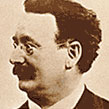
Next to us a large number of Maggi sales people (‘Maggi and Me, the Secret of Goodness’). They were celebrating something. They were all dressed in the same bright red and yellow shirts. I regret I did not take a picture of them; it was such a festive sight. I asked the two white managers, older gentlemen, who did not look half as smart in their shirts as their young Ghanaian salesforce, how one could get a shirt like that and their answer was ‘you work very very hard.’ They emphasized every word in a way that made it seem an unattainable dream and look at the proud wearers of the shirts with some envy. Cabul thought it would be nice to have a uniform like that. It does create an instant and clean sense of belonging. In search of the missed picture I went on the Maggi (=Nestle) website of Ghana and found all sorts of useless but interesting information. There actually was a Mr. Maggi (Julius) julius_maggi.jpgwho founded the famous cubes over 100 years ago. I did also learn that there is a coveted “MAGGI Homowo Kpopoi Manye” title at the grand final event of the Homowo Festival, a harvest celebration in the Ga community around greater Accra. Maggi sponsors cookouts where, I presume, much Maggi is used. This competition has evolved, according to the site, to become not only a key brand-building event for MAGGI, but also for the ethnic group called the ‘Ga.’ Imagine that, brandbuilding for ethnic groups. I am struggling with the concept.


October 2026
M T W T F S S
 1234
567891011
12131415161718
19202122232425
262728293031  

Categories

Blog Stats

  • 144,599 hits

Recent Comments

Olya's avatarOlya on Pocket rollers
Edith Maxwell's avatarEdith Maxwell on Boosted out
Sallie Craig Huber's avatarSallie Craig Huber on Rays for real
Lucy's avatarLucy on Probabilities
Olya's avatarOlya on Cuts

Enter your email address to follow this blog and receive notifications of new posts by email.

Join 83 other subscribers